Showing posts with label Alphabetical Discovery - Week D. Show all posts

Friday, 4 March 2016

Alphabetical Discovery - Week D, Day Seven: Diabolical Masquerade

Diabolical Masquerade - Photo

I stumbled upon Diabolical Masquerade when I was scouring the web for weird/avant-garde/experimental bands - bands that were quite literally a little bit made: Sigh, Kayo Dot, Transcending Bizzare? I found the album Death's Design in a list somewhere and gave it a listen. The album is made up of 61 songs broken up into twenty 'movements'. The entire concept of the album is based around it being the soundtrack for a fictional movie (once actually in the works, but soon dropped). I listened to it and wasn't sure what to think - it jumped around and sped ahead and I couldn't grasp it. It didn't help that some songs were six seconds long and that no lyrics were published. Black-metal passages melt into carnival-esque reveries into folk melodies into electronic video-game ambiance into smooth-jazz - it was fragmented and loose and I loved it. I didn't realise that the madhatter behind the band was Katatonia and Bloodbath guitarist Anders Nystrom alongisde Swedish ever-present ever-eclectic Dan Swano on drums. 

I do not know the band very well outside of 2001's Death's Design, their fourth and final album. 1996's Ravensdusk In My Heart, their first album, is a more 'conventional' record although it still retains gothic, electronic and symphonic elements, although structured in less dramatic ways. Diabolical Masquerade's two albums in between remain a mystery to me, and that's exciting. 


Thursday, 3 March 2016

Alphabetical Discovery - Week D, Day Six: Desaster

Desaster - Photo

Destructive and malevolent black-metal here. I'm going to use an irrelevant and rather pointless analogy: Desaster are black coffee, no sugar or milk - they're just pure black-metal in all its maniacal and evil glory. Desaster's approach takes a lot from the first and second-wave along with an occasional death-doom feel with  vocals leaning towards Martin van Drunen levels of deadly heaviness and riffs edging towards old-school death-levels of gruesomeness. There's also the occasional call-back to a more traditional thrash sound; songs often transition from frantic and pummeling to mid-paced 80's-esque riffing. I don't know if the band mean to be so, but they are fun. The band take their name from a Destruction song, and the band, being German themselves, take a lot from the gravelly German thrash sound. Desaster have released seven full-lengths and each has been consistently excellent. Their last album, 2012's The Art of Destruction, is a monster of an album. The vocals are twisted and intense - just listen to the echo of them on 'Beyond Your Grace' - and there is a certain old-school mid-paced groove that runs through the violence. They have a new album - The Oath of an Iron Ritual - set for release on the 15th of April. If you're in need of some violent black'n'thrash listen to Desaster.


Wednesday, 2 March 2016

Alphabetical Discovery - Week D, Day Five: Dodecahedron

Dodecahedron - Photo

Netherland's Dodecahedron have only released one album, 2012's Dodecahedron - a debut album more well-thought out and interesting than bands that have grafted for years to release something a tenth as good. As their name suggests, Dodecahedron are sharp and angular and their core black-metal sound sharpened with harsh and disharmonious technical and progressive elements; disorienting time-changes merge with a machine-like and robotic space-age atmosphere: this is not raw at all, it's a pristine and glistening industrial assault of unorthodox proportions. 

Although the music itself is jarring the album as a whole works extremely well; the three final tracks being a sort of trilogy - 'View From Hverfell 1, 2, and 3' - that the previous songs work towards. It really feels that way to, whereas the first half of the album is an industrial barrage of floating noises, discordant guitar progressions and pummeling drum-work, the second half seems to become less abrasive and more atmospheric, even conveying a melodic touch with  the odd guitar-solo! The two halves, so to say, are linked by the robotic industrial-ambient 'Descending Jacob's Ladder', five-minutes of disquieting space-age atmosphere; it sounds like being haunted and chased by some demonic spirit, alone, in deep-space, on a creaking and malfunctioning space-station. 

There is a consistent robotic and space-like ambiance to the album that works well with the sharp and angular approach - it is reminiscent of the French black-metal scene, Spektr and Deathspell Omega in particular, but it also reminds me of the atmospheric approaches of Colored Sands era Gorguts and Artificial Brain. Dodecahedron are a very excting band and, from their Facebook page, new music is in its advanced stages of gestation. In fact, the concept of the new album has been talked about - in an interview with Friedhof magazine, the band talks of  the album revolving 'around the five geometric shapes called Platonic solids. These forms have been an inspiration for the songwriting process and will be represented musically on the album. That's all we can say right now!' It seems that the band will continue on their weird geometric black-metal journey!

Tuesday, 1 March 2016

Alphabetical Discovery - Week D, Day Four: Drive Like Jehu


Each week I'd like to have an entry about a band that isn't necessarily 'metal' but these bands are the sort that I expect, or hope, metalheads will appreciate (well at least I do). Drive Like Jehu have been placed in the loose and rather fluid genre-box of post-hardcore; like post-metal, or post-rock, or post-black or post-whatever, the 'post' doesn't really help describe a sound much at all, in fact it's a rather lazy way of grouping bands that that are slightly left-of-centre or slightly off-kilter when compared to others. 

Drive Like Jehu released two albums - 1991's Drive Like Jehu and 1994's Yank Crime - before disbanding a year later. 1994's Yank Crime is a noisy collision of piercing feedback and rusty noise - think a dirty Sonic Youth -, gruff shouted vocals and general off-key grit. This post-hardcore aesthetic, though, is only one piece of the album's dynamic puzzle - melodic and subtle interlocking guitar patterns and moments of textured space-rock slot in alongside the clangor of dissonant riffs that, as in end of 'Luau', sound on the verge of collapse, ringing and wailing like sirens - wires and computer systems locking-down and exploding. With four songs over seven-minutes (two over nine) and with most of the song-endings landing miles away from their blast-off points there is justification in applying the 'progressive' label to the band. But, most importantly, there is a raw energy that pulsates through the entire album; songs like 'Golden Brown', 'New Math' and 'Human Interest' are rip-roaring, throat-ripping, unhinged songs that can rival the intensity of gruffness of a lot of metal from the same time. 


Monday, 29 February 2016

Alphabetical Discovery - Week D, Day Three: Demolition Hammer

Demolition Hammer - Photo

I wouldn't call Demolition Hammer criminally underrated because they're not. Like a lot of just-under-the-surface bands they haven't received the widespread attention - like the Bay Area bands or the Teutonic trio - but that's not to say they've been neglected. At a brief glance - at a time when Metallica and their friends had watered down their sound, at a time when Pantera shook off their glam-rags in favor of fuck-off biker-garb and at a time when Sepultura moved towards their nu-metal roots - perhaps the aggressive and pummeling thrash had lost steam and chugged to stagnancy. But, as there always is, bands like Demolition Hammer along with the likes of Morbid Saint, Exhorder, Dark Angel, Solstice, Sadus and many more, continued - even intensifying - the thrash sound that sent shock-waves through the 80's.

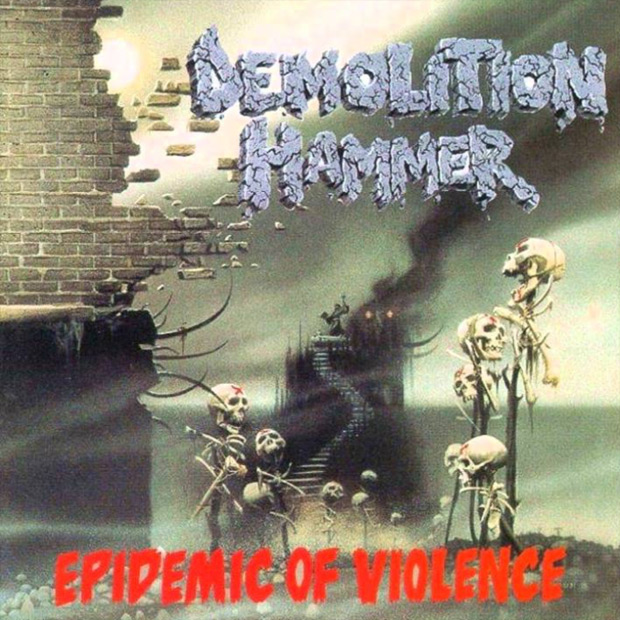
Demolition Hammer - Epidemic of Violence
With three albums, 1990's Tortured Existence, 1992's Epidemic of Violence and 1994's (not so good) Time Bomb, Demolition Hammer - straight outta Com...The Bronx - steamrolled into the 90's turbocharged, leaving grunge and groove and arena-rock mediocrity in their wake, choking on the fumes. Their sound is thrash with the chunkiness of death-metal, a hybrid fueled by a complete fuck-off D.I.Y no-nonsense approach - their awful album artwork, a tradition in thrash, particularly good thrash for some reason, is testament to this.  Epidemic of Violence, the best of the three, is one of the most headbang-able albums, with mostly throttling riffs mixed up with the occasional death-metal chug and mid to fast-paced groove. Lyrically it also leans more towards the gory and ultra-violent, more Carcass and Autopsy than Metallica.

The vocals are, as screamed in 'Skull Fracturing Nightmare', gruesome tools of torture; once again the death-metal hybrid is brought to the fore, the vocals inherently more gruesome and nasty. The drumming is just one of the great things about this album; Vinny Daze's (who died in 1996 after being poisoned by a globefish - I presume after eating one - after attending a tattoo convention in Japan) drumming is a frenzied and unmerciful assault that never lets up. The solos are also great and I like that they retain a certain melody rather than spiraling into noisy wailing (Slayer). I don't know why I keep comparing them with Carcass, but the solos have a much more thrashy Bill Steer-esque quality in my opinion, which is a great thing. Most importantly, Demolition Hammer had an intensity, aggression and mad energy that the best thrash bands had in abundance. 


Sunday, 28 February 2016

Alphabetical Discovery - Week D, Day Two: Darkspace

Darkspace - Photo

In space no one can hear you scream but Darkspace belong to a more terrifying galaxy, a dark space that moans and creaks for light years in all directions. Their music deals with  space, the cosmic void, and the mystical mysteries of the vast dark universe. Their music is dense and smothering and incessant, a neutron star crushing inwards. Formed in 1999 in Switzerland by Wrothe of Paysage d'Hiver and Zhaaral of Sun of the Blind, they've released four full-lengths - the equally ambiguous Darkspace 1, Darkspace II, Darkspace III and Darkspace III I. Everything about their sound seeps darkness. 

The keyboard ambiance is key to their cinematic sound and the movie sample of Hal 9000 from 2010  in '1.1' intensifies the atmosphere that is created throughout their first album and the three albums - pretty much direct continuations - that follow. Darkspace are a difficult band and there isn't a vast amount of differentiation or jarring change in their sound; their music is purposely incessant and repetitive, yet there are subtleties in most songs that, although maybe hard to notice, are captivating - from a change in tone or key of the keyboard  to a slight riff-change, from moments of completely suffocating noise to airy transitions into ambient dark-wave. I suppose it's the ambient black-metal equivalent of funeral doom yet there are more than a fair share of great riffs - from the expected black-metal tremolo riffing to blocks and chugs of reverberating noise. Their music really rewards close listening. It does ask a lot of its listeners but their music creates a stifling atmosphere like no other. 


Saturday, 27 February 2016

Alphabetical Discovery - Week D, Day One: Demilich


Finland's Demilich formed in 1990, releasing only one full-length, 1993's Nespithe, before breaking up and fading into the swampy coldness of the Finnish landscape. Finland produced some rather unnerving and left-of-centre death-metal bands in the 90's - the likes of Demigod, Adramelech, Convulse, Funebre, Abhorrence, Depravity and many more meshing technical flavorings with razor-sharp old-school death and abhorrent and often weird morbid themes.

Spasmodic, rhythmically irregular, jarring with gurgled  vocals  tremble beneath the music like something  slimy disfigured creature from the deep, Demilich were truly an anomaly. There's a bizarre angularity to their sound that sounds genuinely alien - a slimy, crushing, pulsating approach oozing eccentricity. Masked underneath this unearthly multi-dimensional monstrosity are flecks of muddy old-school death-metal - the occasional dissonant solo and spurts of intense blasts and quick fire riffs and melodies. Nespithe doesn't shy away from melody either, although the melodies travel through more unconventional wires. The jarring rhythmical approach resulted in some of the most mesmeric riffs and repetitions I've heard - every songs seems to share a particular thread or pattern that runs from the beginning through to the end, the album has an incredibly satisfying flow. 

Conceptually, the album artwork and lyrics are a perfect extension of their sound - with hyper-detailed song titles like 'The Planet That Once Used to Absorb Flesh in Order to Achieve Divinity and Immortality (Suffocated to the Flesh That It Desired...)' and 'The Sixteenth Six-Tooth Son of Fourteen Four-Regional Dimensions (Still Unnamed)' and 'The Putrefying Road in the Nineteenth Extremity (...Somewhere Inside the Bowels of Endlessness...)' basic cavemen-death grooves and themes are nowhere to be seen or heard in this ultra-weird vomit-infested sun-crushing alternate universe.  

Nespithe is one of the albums I can listen to over and over again and never get tired, there's always something odd - be it a stray bass-line, a partiular riff-pattern, or a particular noise that rises from the tangled 'fourteen four-regional dimensions' - that hooks me in. Part of Demilich's cult status is gathered from how they faded away right after Nespithe; they're touring again now and I'm sure their shows would be incredible. 


Friday, 26 February 2016

Alphabetical Discovery - Week C, Day Seven: Converge


Converge belong to the true sect of metalcore with bands like Earth Crisis, Botch, Coalesce, Zao, The Chariot taking direct influence from the gritty violence of hardcore and punk and the complex heaviness of extreme metal. Chaotic, complex and most importantly heavy, Converge are definitely metal. There is more than a fair selection of completely overpowering grind, crust, black and thrash-metal moments - guitarist Kurt Ballou described their first album, 1994's Halo In A Haystack, as 'a bunch of hardcore kids playing leftover Slayer riffs' - to attract even the purist of extreme-metal fans.

I'd describe them as Pig Destroyers hyper-active, higher-pitched, supersonic twin (they released a split with Scott Hull’s Agoprahobic Nosebleed, incidentally). Converge's music from the early 1990's up to 2001's Jane Doe is a relentlessly sharp attack of shredding shrieks, intense tempo-changes and progressions, chaotic riffs and incredible drum work. Ben Koller's drumming is some of the best you'll hear, an unrelenting force of nature. Their third album, 1998’s When Forever Comes Crashing, is my particular favourite: a melting-pot of chaotic hardcore, mathcore, and thrash with slabs of industrial noise. 2001's Jane Doe is their pinnacle - a skin-shredding 45-minute assault that also experimented with suffocating industrial and doom-like sections. Converge are probably one of the most energetic and visceral bands, but their approach, particularly from Jane Doe onwards, is not purely an all-out assault - there are many moments and songs that morph and change from chaos to slow and sludgy, trance-inducing doom in the vein of Godflesh and more contemporary bands bands like Indian and Thou ('The Lowest Common Denominator' is a good example of this). There is a great diversity to their sound and pigeon-holing the band doesn’t do them justice.

I wouldn't say that black-metal is a direct influence on the band, or something that has been purposely utilised in their music, but their sound is an intensification of hardcore, punk and - to a certain extent - speed and thrash, four styles that were partly merged to form the evil atmospheric sounds of the first and second-wave black-metal bands. I'm sure that if Converge really wanted to be a black-metal band they'd be a very good one, but their sound is closer to the US hardcore-punk scene of the 80's and 90's.

So many bands get derivatively labelled and grouped as being one thing, although Converge have managed to break out of the derogative metalcore/mathcore rubbish heap. Often – in metal circles - people who speak of metalcore, or hardcore even, are shunned from the circle as lepers are from the populace. Perhaps such repulsion is partly to do with the fan base that these ‘genres’ attract, but there really are some great bands with great riffs and a great sound buried beneath watered-down bands like Killswitch Engage and Hatebreed. I’m going to stop here because I’m just ranting about things that have been said over and over again for years. Converge are good.