Showing posts with label Alphabetical Discovery - Week C. Show all posts

Thursday, 25 February 2016

Alphabetical Discovery - Week C, Day Six: Cryptopsy


I'm just going to jump right in and talk about None So Vile, Cryptopsy's second - and best - album, and arguably one of the best extreme metal albums. Many bands have attempted to perfect that art of the unruly, the schizophrenic, the chaotic, but none come close to the 32-minutes of complete and utter freakishness that 1996's None So Vile manages to ooze.

None So Vile opens with a roaring demon dinosaur type creature welcoming us into the mad-world; indecipherable lyrics - including a notable selection of references to anal play - and inhuman vocals layered above rapid drumming and unstable guitar sounds that happen to contain both a brain-numbing difficulty and an incredible level of groove. There is so much groove invisible behind the cacophony as in 'Grave of the Fathers' for example. This is unconventional brutal-death, the parameters of straight-forward death turned on its head, floating in a bizarre space defying gravity and the laws of conventional music. This is all incredibly dramatic and hyperbolic but I think a cautious approach does the album no justice whatsoever - sometimes you have to go a bit crazy. 
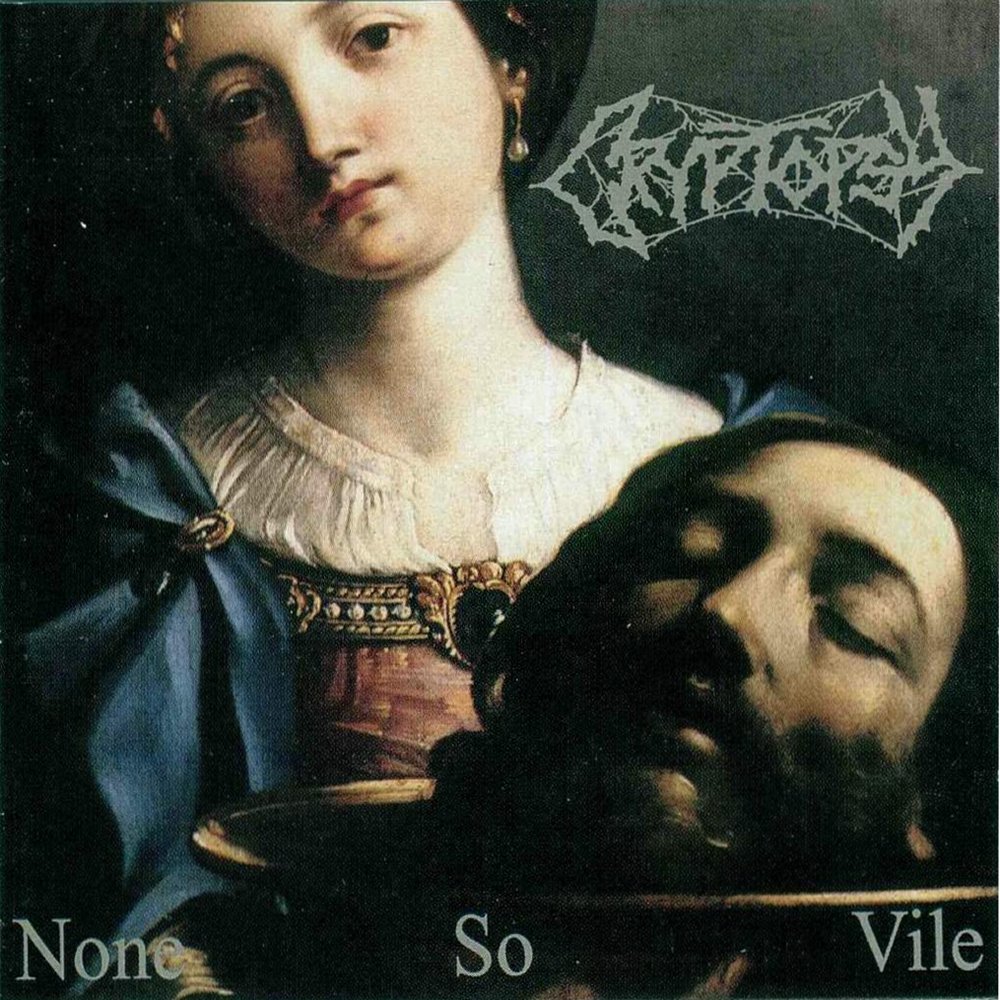
Cryptopsy - None So Vile
Lord Worm's vocals are made up of some of the most disgusting sounds known to man: diseased and frothing gargles, spewing gurgles, razor sharp snarls, excruciatingly painful groans, piggish snorts, heart-wrenching shrieks, cannibalistic growls - not many other vocalists touch the complete madness of his vocals; they are unstructured and loose, but this unruliness is more of selling-point than a weakness. The vocals are like the cries at an exorcism, some brutal demon pouring from the portal of the throat; this is how the closing sections of 'Benedictine Convulsions sounds. Lord Worm now teaches English - those poor children.


Combining and controlling all of this chaotic unruliness must be a difficult task, yet there is a cohesive unstructured structure to the album; there are immensely good riffs that never linger too long, that always mutate and move on to the next - the band must have sold their soul to the devil for a bottomless pit of riffs because almost every transition is mesmeric. This is attenuated by the maniacal drumming of Flo Mounier - it's difficult to really put my finger on what it is so I'm just going to be completely hyperbolic about describing this too: it's a multi-dimensional, warped, multi-armed piston-heavy explosion of blast-beats, hat-riding, and bellowing rhythmic annihilation. It's an acquired sound; the snare is pronounced, at times sounding hollow, but it works with the album, it's purposely not meant to sound clean or fluid.

The bass is the same; it's played with the panache of a classical or flamenco guitarist - fingers and bass strings stomping and swinging about with such incredible energy. It doesn't really sound like a bass - it transcends the boundaries of sound, curving and warping as the waves tumble through the air. There are also moments of beauty and semi-conventionality carried through brief solos and spurts of rhythm - 'Slit Your Guts' is an example of this. 

Cryptopsy's first album Blasphemy Made Flesh has a much grittier production, it perhaps does not contain the overly-spasmodic tendencies of None So Vile but from an outsiders it's just as unconventional; the bass seems to ping with even greater clearness due to the production on Blasphemy Made Flesh, the vocals are maniacal if slightly more conventional and the drum-work once again pummeling. Their third album, Whisper Supermacy, is also worth checking out despite no Lord Worm on vocals, the instrumentals are still mind-boggling. After that album my knowledge is a bit more hazy - there was that one album that shall not be named. Their 2015 E,P The Book of Suffering was actually decent, but it lacked something, it dropped pretty quickly onto the ever moving conveyor belt of good but not incredible music.



Wednesday, 24 February 2016

Alphabetical Discovery - Week C, Day Five: Cirith Ungol


In 1972, riding dragons arising from the sandy vistas of California, Cirith Ungol breathed their first eccentric flames. They didn't release anything until 1980's debut full-length Frost and Fire, a more conventionally heavy-metal record that flaunted elements of the eccentricities - croaking, higher-pitched, goblin-throated vocals and an engulfing bass lead sound - that would catapult Cirith Ungol into power-doom-progressive realms with their three later releases.

'Atom Smasher' opens 1984's King of the Dead album - its bubbling, warped bass lines ensnaring as strained vocals welcome the listener to 'the brave new world' and guitars progress and solo into an atom-smashing oblivion: this is just the tip of the iceberg, an example of things to come. Perhaps jarring at first, the odd production and idiosyncratic vocals, for me at least, grow more endearing and ultimately work in harmony with the fantastical themes. Yet underneath the quirky soundscapes are incredible instrumentals - there are speed-riffs, doom-riffs, psychedelic-riffs, punk-riffs, jazz-riffs, jazz drumming, thrash-drumming: riffs to satisfy all your needs! Cirith Ungol's sound is ultimately a power-doom hybrid - part Sabbath, part Rush, part The Grateful Dead. 

And the doomier elements - not to say the other aspects are sub-par - are strikingly good: the seven-minute 'Master of the Pit' a particular example of quirk mixed with an aggressiveness and a bluesy-progressiveness; 'King of the Dead' a downcast journey; 'Finger of Scorn' a conflict between folky-prog and expansive doom. 1986's One Foot In Hell and 1991's Paradise Lost are equally as interesting, with songs about doomed planets and  trolls (a song about the internet way before its time) and even a cover of 'Fire' by Arthur Brown. First reactions might be 'what the hell am I listening to?' but after the initial tumult of banshee wails, pulsating solos and crazy progressions you'll be sucked into a memorable and endearing world.


Tuesday, 23 February 2016

Alphabetical Discovery - Week C, Day Four: Can


Kraut: hypnotic and psychedelic, mesmeric and repetitious, ritualistic and frenzied; Can's sound is a tribal frenzy of world-music, jazz, noise, rock, progressive...it's neither one thing or another. Their music transcends and infuses from structured sections through to semi-improvisational groove passages, from minimalist ambient whirling to jazzy bursts of energy; from progressive-rock flamboyancy to disordered proto-punk- in the context of 'extreme' metal, I don't think it's unfounded to say that Can must have had some influence on noise, drone, ambient, progressive and whatever-else bands today. The whole German kraut scene in the 60's/70's - Faust, Neu, Can some of the big 'uns - paved the way for experimentation within a rock/pop framework. 

Their first five releases - Monster Movie (1969), Soundtracks (1970), Tago Mago (1971),Ege Bamyasi (1972) and Future Days (1973) - are exercises in musical discovery and freedom. That sounds pretentious but it is rather apt. Fluid, unconventional, intense and dense (quality rhyme there), Can were truly ahead of their time. From the 17-minute world-music drone/noise song 'Aumgn' sounding like something from an Om album or 'Peking O' sounding like a descent into  John Zorn or Mr. Bungle levels of madness just being the peak of this musical ice-berg, it's worth just jumping in and getting lost in the sounds. 


Monday, 22 February 2016

Alphabetical Discovery - Week C, Day Three: ColdWorld

ColdWorld - Photo

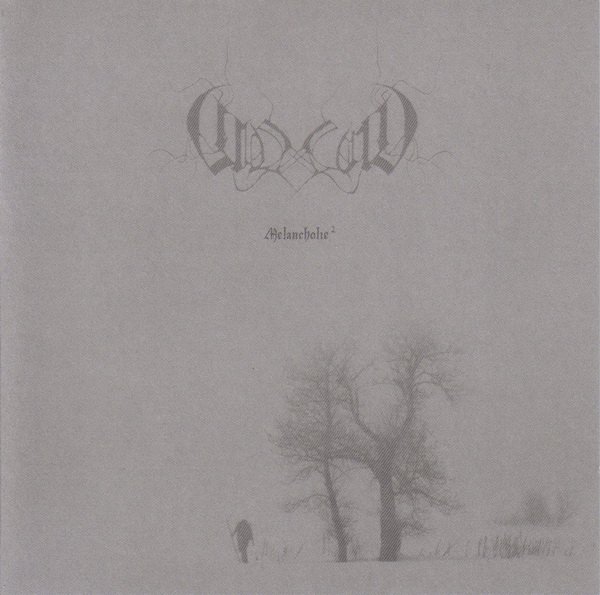
ColdWorld is a one-man ambient black-metal project based in Leipzig, Germany. 2008's Melancholie² was Georg Börner's last release but, excitingly, there is new music scheduled for release sometime in the next year, or two...or three. An extension of the ambient coldness of Burzum's Filosofem, ColdWorld's sound consists of shimmering atmospheres layered upon raw sharpness; there are a lot of atmospheric bands that are heavily influenced, some even blatant rip-offs, by Burzum's sound - ColdWorld are obviously influenced but there is much more to the music than shameless copying.

ColdWorld - Melancholie²Melancholie² is has a genuinely vast and expansive sound similar in richness to Darkspace and Paysage d'Hiver; synths and heavily distorted guitars seep and swirl. It's much more alluring than the barren intensity of Darkspace, however - there is a much greater reliance on melody and harmony as violins hum and synths float with less ominousness; it is the sound of melancholy that draws influence from depressive and dark-ambient sub-genres. Production wise the guitar tones are pretty lo-fi, the drum-work programmed, and the vocals seem to levitate above the mix, yet there is something rather appealing and enticing about the production, from my warped mind at least. I like the rough, synthetic quality of many atmospheric projects, I like image of these atmospheric worlds being created from absolutely nothing into something as expansive and immersive as ColdWorld's music; a lot think it simple and easy to do and this, regrettably, means there is a lot of wet and cold atmoshperic shite out there, but when you have the skill and direction to pull such a venture off, the output can be some of the most imaginative and engrossing extreme-metal. Off the top of my head there are bands like Spectral Lore, Midnight Odyssey, Panopticon, Elysian Blaze, Burzum, Mare Cognitum, Saor, Paysage d'Hiver, The Ruins of Beverast and most likely a diverse range of other one-man projects making genuinely colorful and creative music from the confines of their blackened rooms.


Sunday, 21 February 2016

Alphabetical Discovery - Week C, Day Two: Colosseum

Colosseum - Photo

Colosseum's funeral-doom sound is intensely dreamlike and oddly comforting at times; it dwells in despair with its slow dirge-like progressions but its ambient overlays are, at times, angelic, even soothing; 'Weathered',from their first album Chapter 1: Delirium (2007), is one such song. The ambient sounds move with a lightness that lifts the crunching slabs of guitar and the growls into an ethereal soundscape. There are dramatic orchestral elements - groups of violins, cellos, etc. - that truly forges a sense of grandeur. The majority of Colosseum's songs are long, reaching in to the double-digits, yet they never seem to lose focus or fizzle out; there is always something dragging you back in - an example of this, once again, in the closing minutes of the thirteen-minute 'Weathered' where the pace picks up: double bass drums rumble and riffs and solos burst from their languid states of despair into something more energetic as the orchestral continue to swirl and throb. Their sound is melancholic and forlorn with more than a fair share of beautiful pirouetting guitar leads and dense melodies. It's the sound of something emerging from a thick fog, entrancing and vexing as it's shadow creeps into light.  There are so many subtleties and variations weaving and seeping through each song, it's a true auditory experience.

The Finnish band disbanded in 2010 following the death of vocalist and guitarist Juhani Palomäki aged 32.Their third album, which was in the works before Palomaki's death, was released posthumously in 2007, titled Chapter 3: Parasomnia. Their three albums are interconnected, each a progressive chapter, each centering themes of desolation inside a Lovercraftian and Sumerian mythological world. It's terribly sad for anyone to die so young; it's particularly sad to see such an interesting band stopped at their prime.  


Saturday, 20 February 2016

Alphabetical Discovery - Week C, Day One: Code


Code are a band from England formed in 2002. I write that in the most minimalist way possible because its is near impossible to accurately categorise their sound, yet I suppose I should try. A progressive black metal sensibility is the fundamental driving force of their early output but their albums warp and modify sometimes beyond the realms of metal, leading to the expansive melancholy of their current post-rock output. 'Experimental' is a tag stuck on to bands that are often hard to pin down or define but Code, I'd say, are a band who actively experiment and try to develop their sound from album to album.

In Code's DNA are touches of straight-forward black-metal - particularly in their first two albums: 2005's Nouveau Gloaming and 2009's Resplendent Grotesque - alongside an expansive progressive and melodic sound akin to more recent Enslaved and Borknagar; beyond this songs regularly reach must vaster and unpredictable dimensions - unorthodox and stylistically similar to Scandinavian experimenters Arcturus, Solefald and Diabolical Masquerade. There is also a particular quirky Englishness - especially from third album Augur Nox onwards (with new vocalist Wacian) - comparable to the Triple-A attack of Akercocke, A Forest Of Stars and Anathema . Despite my blatant attempt at deciphering their sound through comparisons with a hotchpotch of other extreme-metal bands, there is a much wider essence and diversity to Code's music that reaches far beyond metal. 

Code's smooth transition into more alien territories began with their third album Augur Nox, an album that bridged the gap between two soundsThe Surrey band's most recent album - 2015's Mut - paints on a much wider canvas, exploring post-rock and progressive soundscapes with their idiosyncratic approach to song-writing and atmosphere. A much more reflective and melancholy sound makes up the core of the album and their change of direction draws similarities with Anathema's excellently executed transition from doom through to their alternative sound. Mut is an incredibly interesting and nuanced progressive album that draws more similarities with Porcupine Tree and Soen. You can tell that a lot of thought and a lot of hours has gone in to each sound, transition and effect in Code's music; they are a richly textured and diverse band that will kick-start even the blandest of imaginations.